For damage-focused Operators, Cold-Blooded is particularly strong on Sharpshooters, while The Bigger They Are… excels against Elites and Bosses.
Talents are only one part of an Operator’s build. Each Operator also has a Focus Tree, where you spend Focus Points to improve their Talent, Specialization Abilities, and Passives.
This matters because several Talents become dramatically stronger at their final Focus Tree rank rather than simply gaining a small numerical increase.
1. Best Talents in Star Wars Zero Company
A Life of Labor Talent
There are 10 universal Talents available to Custom Operators. An Astromech has its own separate Built-In Comlink Talent, while authored story characters use unique Talents that cannot be selected by normal recruits.
A Life of Labor, Anticipation, and Grit are the strongest general-purpose choices, while the remaining Talents become better when matched with the right Specialization.
| Rank | Talent | Best Use |
|---|---|---|
| 1 | A Life of Labor | Best overall stat boost |
| 2 | Anticipation | Avoiding attacks and protecting vulnerable Operators |
| 3 | Grit | Frontline survival and tank builds |
| 4 | Cold-Blooded | Guaranteed Critical Hits |
| 5 | The Bigger They Are… | Elite and Boss damage |
| 6 | Taunt | Heavy and defensive builds |
| 7 | Sabotage | Environmental explosives |
| 8 | Fortitude | Fighting while Injured |
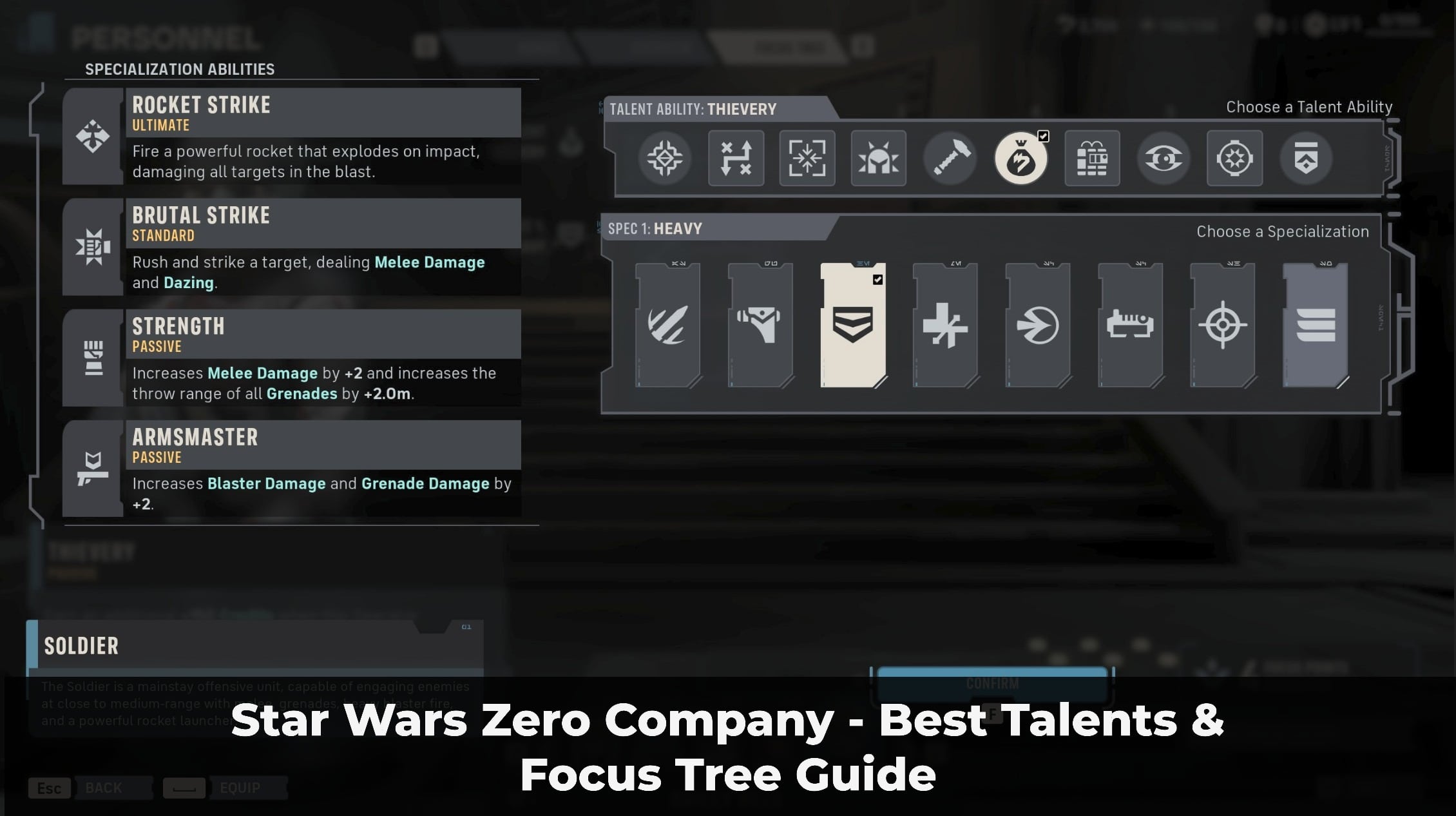
| 9 | Thievery | Extra Credits |
| 10 | Espionage | Extra Intel |
1.1. A Life of Labor – Best Overall Talent
A Life of Labor Talent
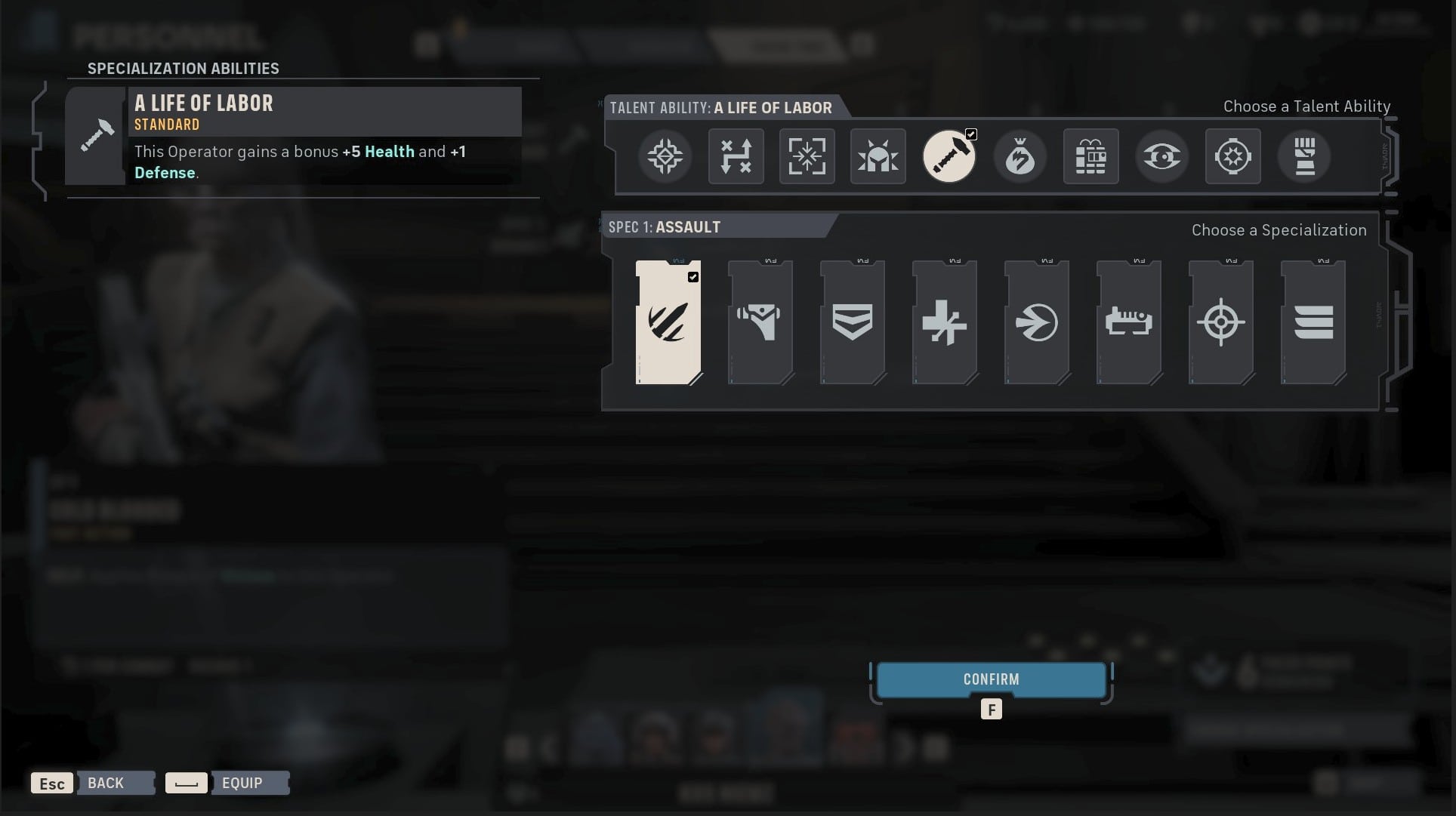
A Life of Labor is the easiest Talent to recommend for almost any Custom Operator. It has no enemy-type requirement or Injury condition and simply makes the Operator stronger. Its Focus Tree ranks provide:
| Rank | Effect |
|---|---|
| I | +5 Health, +1 Defense |
| II | Above bonuses +2 Melee Damage |
| III | Above bonuses +2 Critical Hit Damage |
| IV | +7 Health, +2 Defense, +4 Melee Damage, +4 Critical Hit Damage |
It works particularly well on:
- Assault
- Soldier
- Heavy
- Gunslinger builds that need additional survivability
If you recruit an Operator and are unsure which Talent to use, A Life of Labor is the safest default.
1.2. Anticipation – Best Evasion Talent
Anticipation gives the Operator Evasion, causing an incoming attack to miss. Upgrading it through the Focus Tree greatly increases how often you can use the effect.
| Rank | Effect |
|---|---|
| I | Gain 1 Evasion once per turn |
| II | Can be used twice per turn |
| III | Can be used three times per turn |
| IV | Can also be applied to an ally |
Best pairings include:
- Gunslinger
- Medic
- Scoundrel
- Scout
It is particularly useful on support Operators who occasionally need to move into exposed positions to revive, heal, scout, or complete objectives.
1.3. Grit – Best Defensive Talent
Heavy Specialization
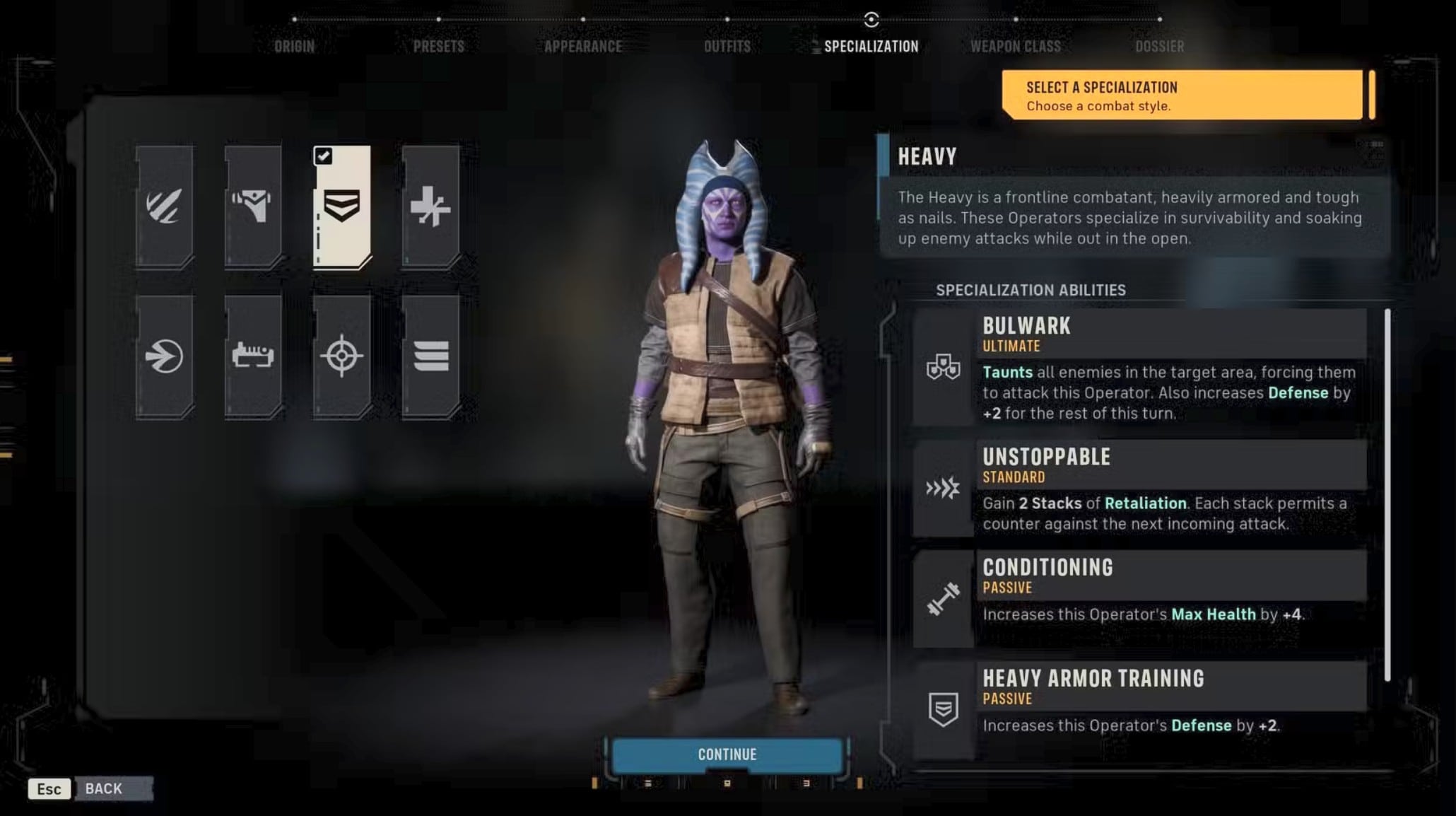
Grit is the strongest Talent for a frontline Operator. It applies Invulnerable, which prevents all damage from the next incoming attack, and also increases maximum Health.
| Rank | Effect |
|---|---|
| I | +2 Health and 1 Invulnerable stack |
| II | +4 Health |
| III | +8 Health |
| IV | +12 Health and 2 Invulnerable stacks |
This is an excellent Heavy Talent because Heavy Operators naturally draw more enemy attention. It is also strong on Assault or Soldier characters expected to fight near the frontline.
If you are playing on a harder difficulty or with Beskar Mode/permadeath, Grit’s ability to completely negate attacks becomes even more valuable.
1.4. Cold-Blooded – Best Critical Hit Talent
Cold-Blooded applies Vicious, causing the Operator’s next attack to become a guaranteed Critical Hit. This makes it one of the strongest offensive Talents for high-damage single-target builds.
| Rank | Effect |
|---|---|
| I | 1 Vicious stack once per combat |
| II | Two uses per combat |
| III | Three uses per combat |
| IV | Applies 2 Vicious stacks |
The strongest pairing is:
Sharpshooter + Cold-Blooded
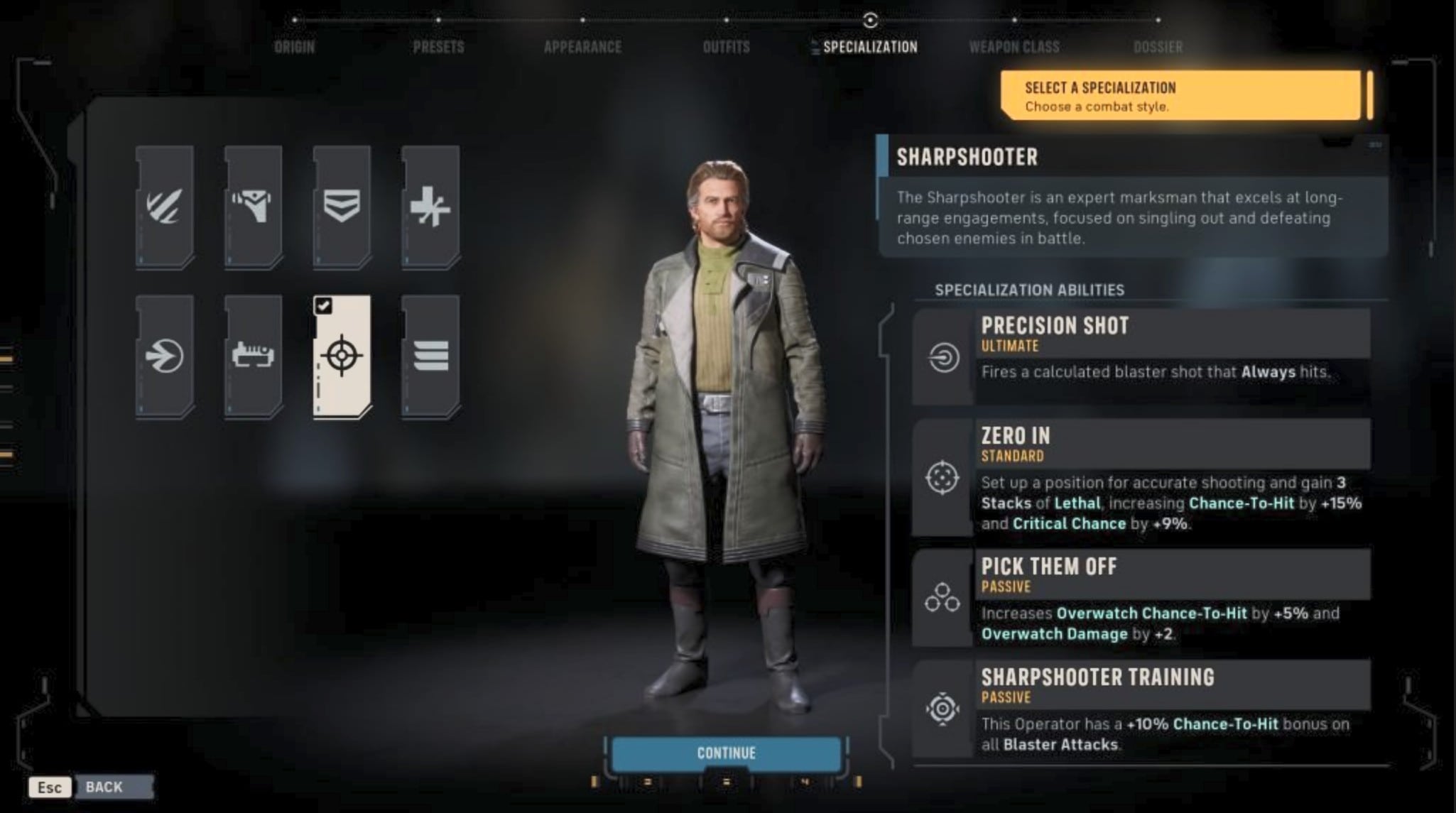
Sharpshooters already specialize in accurate, high-damage attacks, so guaranteed Critical Hits make them even better at removing priority enemies.
It can also work with Scoundrel, particularly if you want that Operator to personally exploit Critical Hits instead of only setting up Vulnerable targets for teammates.
1.5. The Bigger They Are… – Best Boss Talent
Sharpshooter
The Bigger They Are… directly increases ranged and melee damage against Elite and Boss enemies. Its Focus Tree upgrades simply increase that damage bonus.
This is another strong Sharpshooter Talent because Sharpshooters are normally used to eliminate dangerous priority targets.
The downside is that the Talent provides no bonus against normal enemies, which makes Cold-Blooded more flexible across regular missions.
| Rank | Elite/Boss Damage |
|---|---|
| I | +2 |
| II | +3 |
| III | +4 |
| IV | +6 |
1.6. Taunt – Best Heavy Talent Alternative
Taunt forces one selected enemy to target the Operator. Upgrading it through the Focus Tree also reduces that enemy’s damage.
| Rank | Effect |
|---|---|
| I | Taunt one enemy once per turn |
| II | Target deals 2 less damage |
| III | Target deals 4 less damage |
| IV | Target deals 6 less damage |
The obvious pairing is Heavy + Taunt.
Use the Heavy to pull a dangerous enemy away from a vulnerable Medic, Sharpshooter, or wounded squad member while reducing that enemy’s damage at the same time.
For pure survivability, Grit is still the safer choice. Pick Taunt when you want your Heavy to actively protect other Operators.
1.7. Sabotage – Best Environmental Talent
Sabotage lets the Operator remotely detonate explosive objects on the battlefield. Its usefulness depends heavily on the map, but the Focus Tree eventually removes its usage limit entirely.
| Rank | Uses |
|---|---|
| I | Once per combat |
| II | Twice per combat |
| III | Three times per combat |
| IV | Unlimited |
Sabotage is a good fit for Scout, since Scouts already focus on battlefield setup and creating opportunities for the rest of the squad.
Its problem is consistency. On maps without useful explosive objects, you effectively lose much of the Talent’s value.
1.8. Fortitude – Best Injured Talent
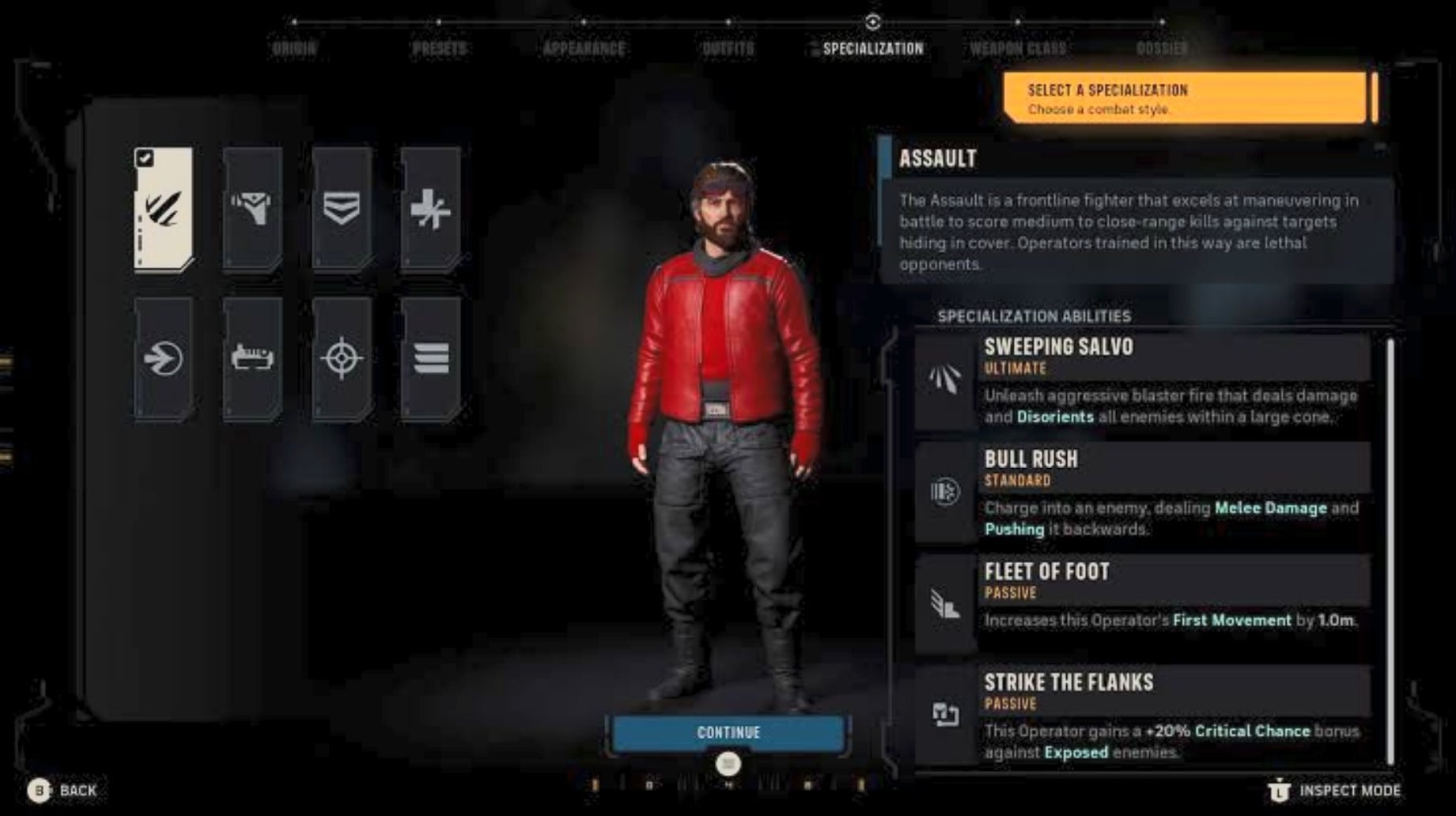
Assault
Fortitude increases Defense whenever the Operator is Injured. The final Focus Tree upgrade also removes the normal Chance-to-Hit penalty caused by Injury.
| Rank | Effect While Injured |
|---|---|
| I | +2 Defense |
| II | +3 Defense |
| III | +4 Defense |
| IV | +6 Defense and removes Injury accuracy penalty |
Fortitude becomes useful when an important Operator is Injured but you still need to deploy them.
It works best on:
- Heavy
- Assault
- Soldier
However, it ranks below Grit and A Life of Labor because those Talents provide benefits before your Operator becomes Injured.
1.9. Thievery – Best for Credits
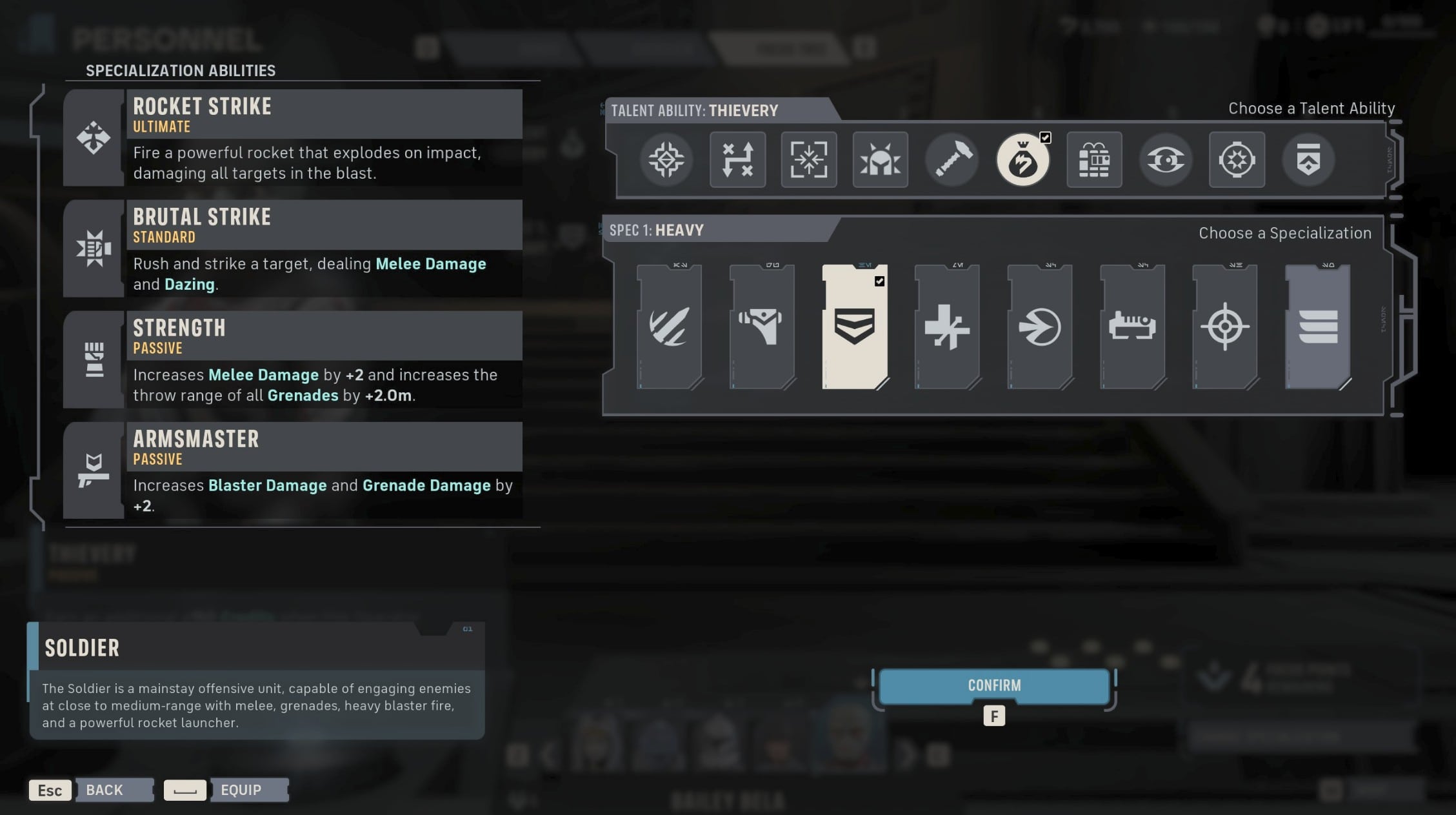
Thievery Talent
Thievery increases the Credits earned whenever the Operator completes a combat mission. Multiple Thievery bonuses do not stack, so you only need one Operator using it.
This is useful once your squad is already strong enough that losing a combat Talent is not a major problem.
I would not prioritize Thievery early, when surviving missions and keeping Operators healthy matter more than earning a few additional Credits.
| Rank | Extra Credits |
|---|---|
| I | +150 |
| II | +200 |
| III | +250 |
| IV | +300 |
1.10. Espionage – Best for Intel
Espionage is the Intel equivalent of Thievery. It increases the Intel earned after combat missions and does not stack.
Put Espionage on a Medic or Scout if that Operator already performs their role comfortably without needing a stronger combat Talent.
| Rank | Extra Intel |
|---|---|
| I | +5 |
| II | +7 |
| III | +9 |
| IV | +12 |
2. How to Use Focus Tree
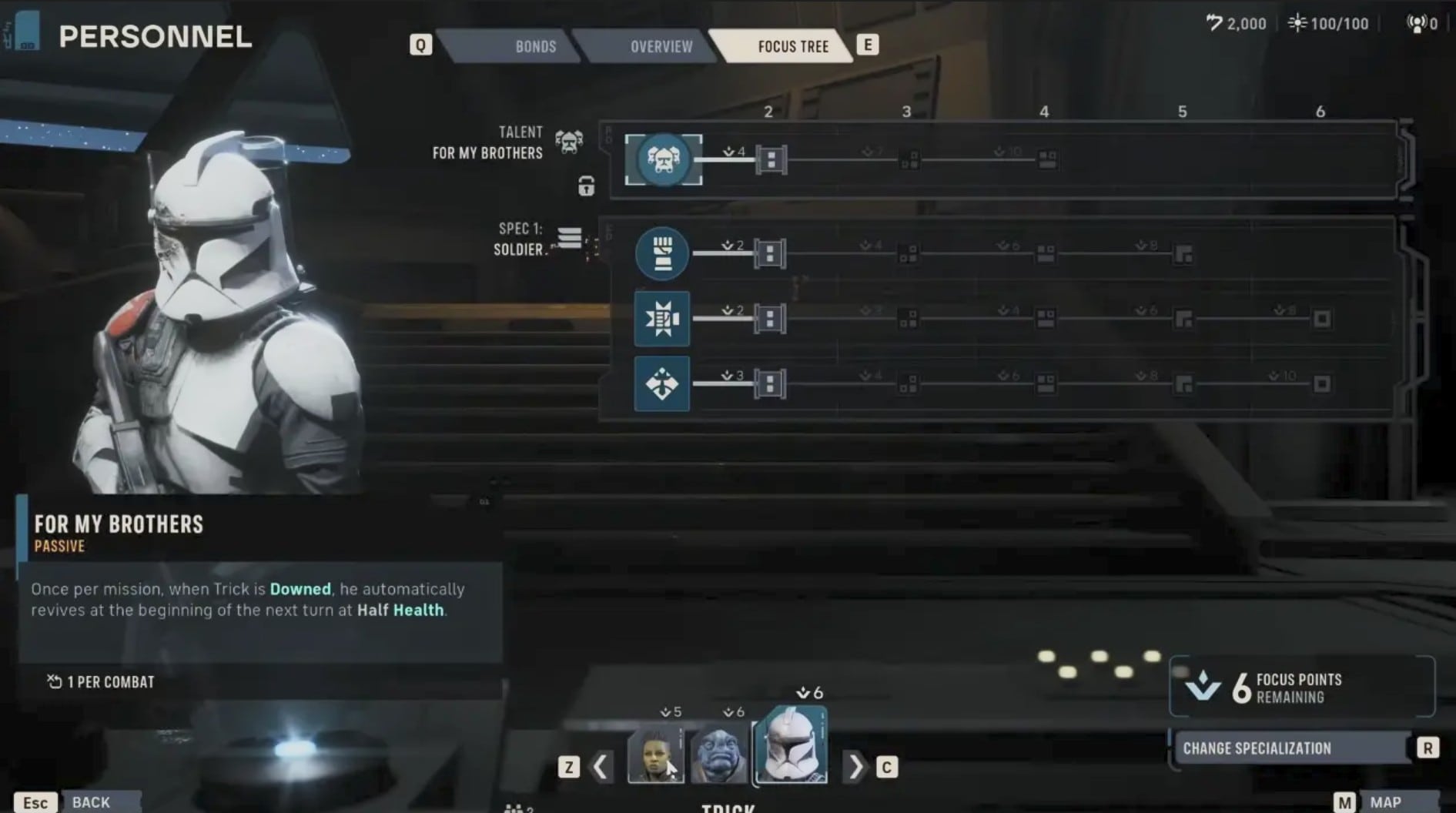
Focus Tree
The Focus Tree is the actual progression system used to upgrade Talents. At the Personnel Facility in The Den, every Operator has a Focus Tree containing their Talent alongside their Specialization’s Abilities and Passives. You earn Focus Points from the following.
- Increasing Bonds between Operators
- Completing certain Tactical Missions
- Completing progression that awards Focus Points
You then spend those Focus Points in the Focus Tree to improve Talents, Specialization Abilities, and Passives.
Increasing Bonds is the primary source of Focus Points, which means regularly deploying the same useful Operator pairs also speeds up their build progression.
2.1. Best Focus Tree Priority
Do not automatically dump every Focus Point into the Talent first. Talent upgrades and Specialization upgrades use the same progression system, so spend according to which upgrades materially improve the build.
A good general priority is:
- Unlock the core Specialization ability your build relies on.
- Upgrade your chosen Talent when its next rank provides a meaningful improvement.
- Improve the Specialization’s strongest Passive or Standard Ability.
- Push the Talent toward Rank IV if its final effect is particularly valuable.
- Finish secondary abilities afterward.
3. Best Talent for Every Specialization
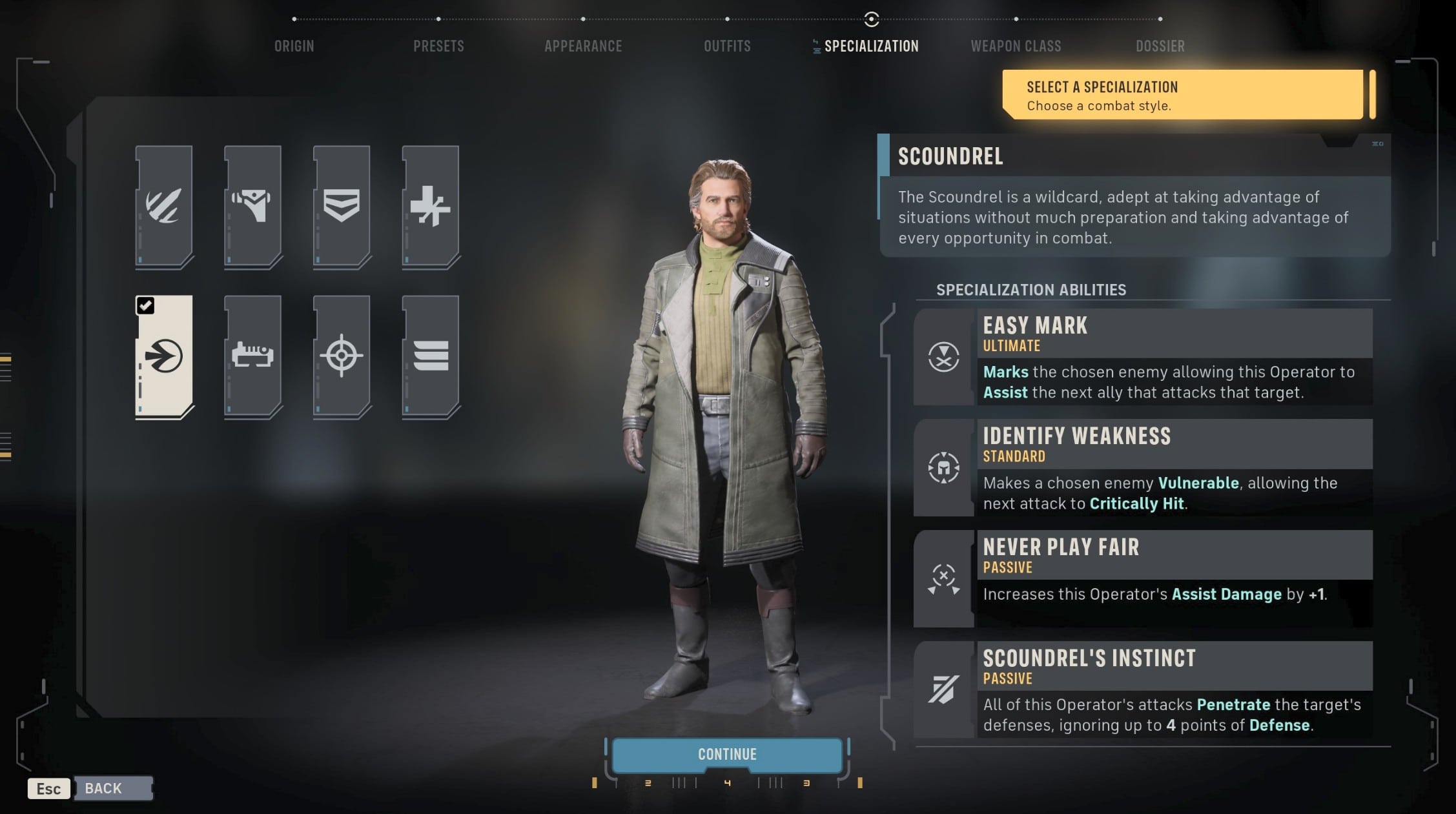
Scoundrel Specialization
Talents and Specializations are separate systems, which means the best build comes from pairing a Talent with a class whose mechanics benefit from it.
| Specialization | Best Talent | Alternative |
|---|---|---|
| Assault | A Life of Labor | Grit |
| Gunslinger | Anticipation | A Life of Labor |
| Heavy | Grit | Taunt |
| Medic | Anticipation | Thievery |
| Scoundrel | Anticipation | Cold-Blooded |
| Scout | Anticipation | Sabotage |
| Sharpshooter | Cold-Blooded | The Bigger They Are… |
| Soldier | A Life of Labor | Grit |
3.1. Best Combinations
You do not need to force every Operator into the same three Talents. A Life of Labor, Anticipation, and Grit are the best general choices, but specialization-specific combinations can be better. A few combinations stand above the rest:
- Heavy + Grit: The Heavy draws pressure while Invulnerable and extra Health keep it alive.
- Sharpshooter + Cold-Blooded: Guaranteed Critical Hits reinforce the Sharpshooter’s single-target role.
- Assault + A Life of Labor: Extra Health, Defense, and melee damage complement close-range aggression.
- Medic + Anticipation: Gives your healer additional protection when moving into dangerous positions.
- Scoundrel + Anticipation: Keeps the Scoundrel safe while setting up Vulnerable and Assist opportunities.
- Scout + Sabotage: Adds another battlefield-control tool, although it depends on environmental explosives.
4. Hawks and Story Operator Talents
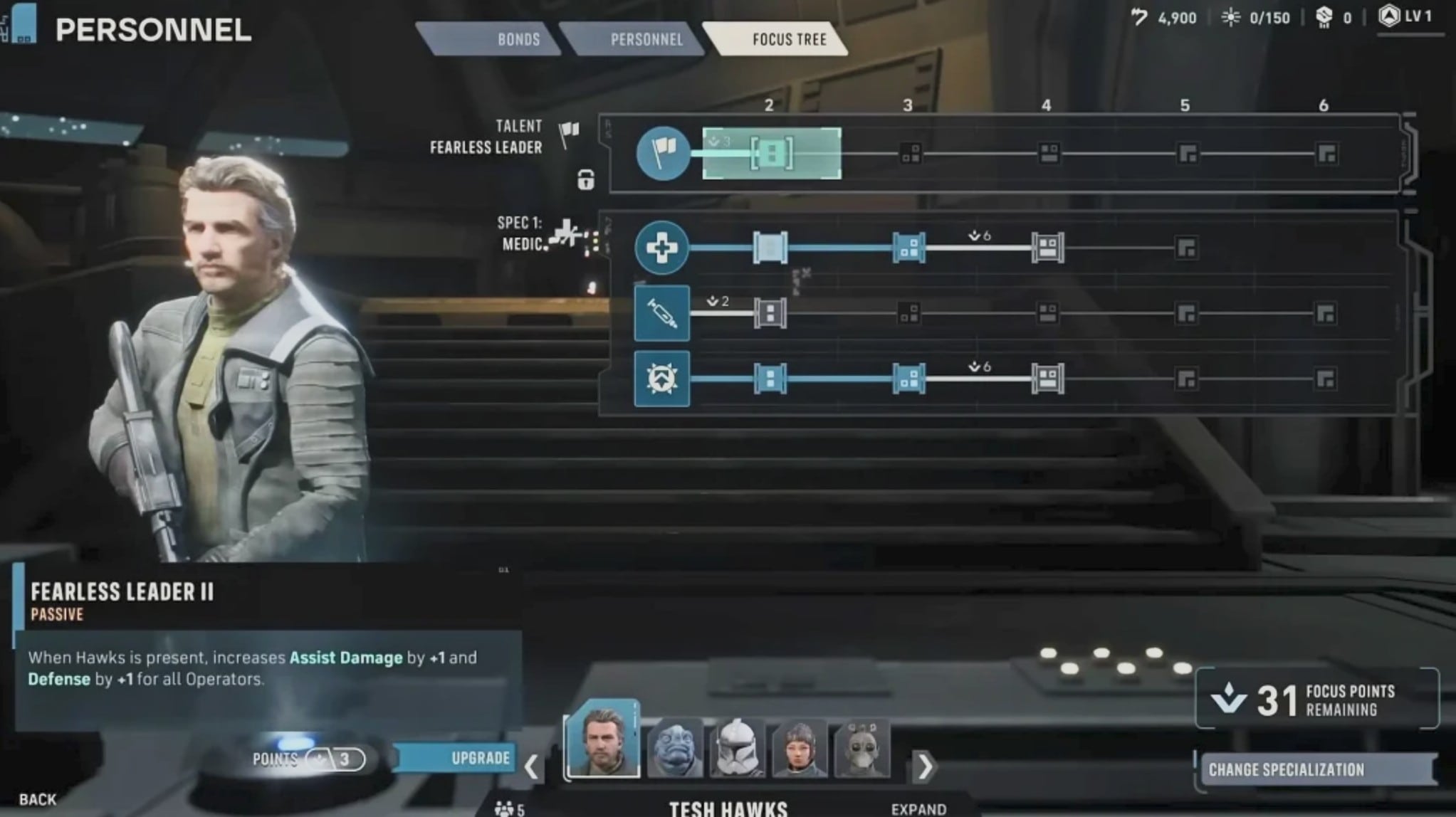
Fearless Leader
Hawks is different from a Custom Operator. His Talent is the unique Fearless Leader, which remains attached to him even if you change his Specialization.
Fearless Leader improves the squad’s Assist Damage and Defense while Hawks is present, with stronger bonuses as you invest additional Focus Points into the Talent.
| Rank | Fearless Leader Effect |
|---|---|
| I | +1 Assist Damage |
| II | +1 Assist Damage, +1 Defense |
| III | +2 Assist Damage, +1 Defense |
| IV | +2 Assist Damage, +2 Defense |
| V | +3 Assist Damage, +2 Defense |
| VI | +4 Assist Damage, +3 Defense |
5. How to Respec Talents and the Focus Tree
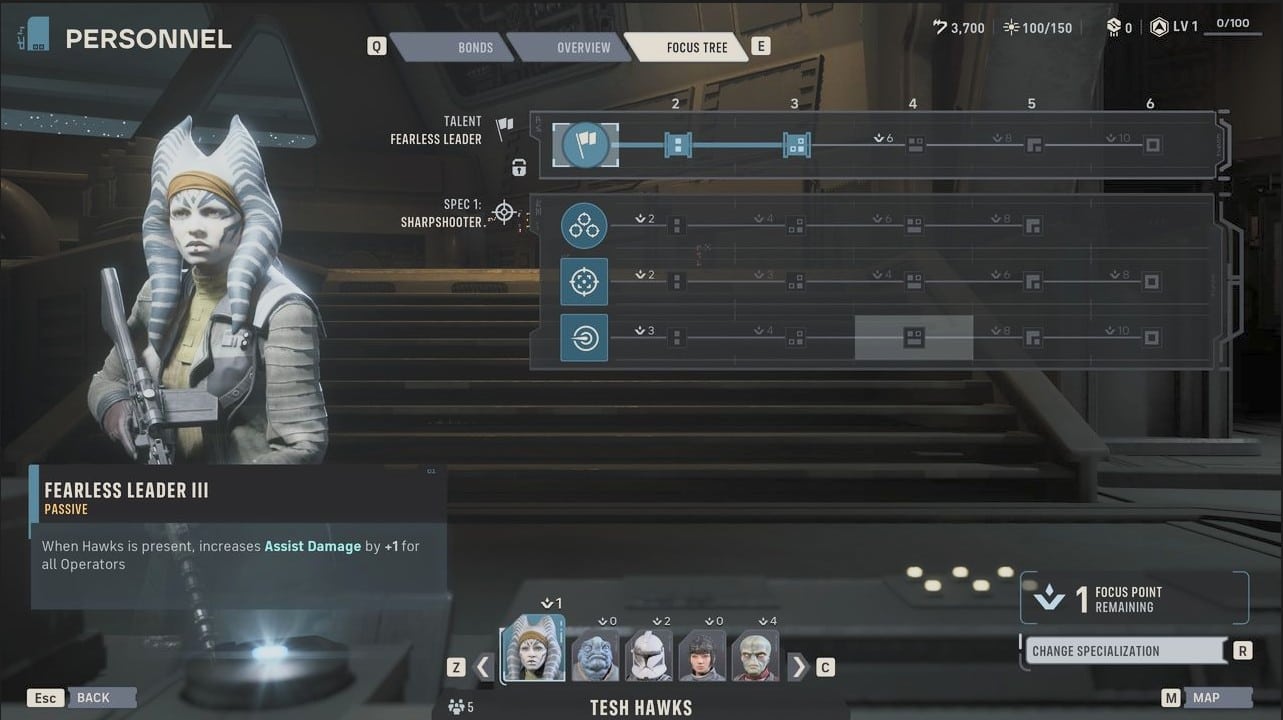
Focus Point Respec
You unlock full respeccing very early, around Cycle 3. It is handled from the Personnel console in The Den.
- Go to the Personnel console beside the map table.
- Select the Operator you want to change.
- Open the Focus Tree tab.
- Select Change Specialization.
- Choose a new Specialization if needed.
- Redistribute the refunded Focus Points through the new Focus Tree.
Changing a Specialization is free and refunds the Focus Points invested in that Specialization’s tree. Focus Points invested into a story character’s fixed Talent are not refunded when changing their Specialization, because that Talent remains attached to the character.